publications
2026
- ReVo
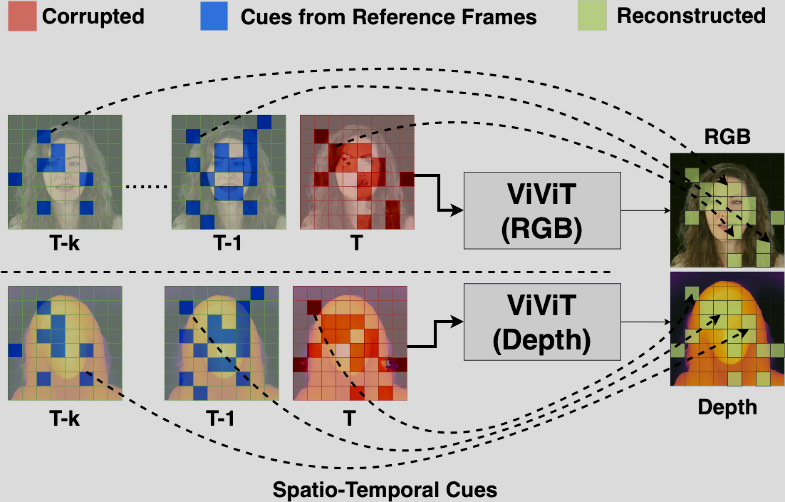 ReVo: A Cross-Layer Reliable Volumetric Videoconferencing SystemAnkur Aditya, Diptyaroop Maji, Lingdong Wang, and 3 more authors2026
Volumetric videoconferencing enables immersive six Degrees of Freedom interactions by jointly transmitting visual appearance and 3D geometry. However, delivering volumetric video over today’s networks remains challenging due to high bandwidth demands, strict real-time latency constraints, and frequent packet loss. We present ReVo, a loss-resilient volumetric videoconferencing system that jointly recovers RGB and depth content under packet loss while meeting real-time constraints. It decouples volumetric video into RGB and depth streams, selectively protects critical content using network-layer FEC, and reconstructs corrupted non-critical frames using a post-decode neural recovery module. Our evaluations using real-world loss traces show that ReVo improves median SSIM by up to 32% for RGB content and 13% for depth content, and reduces video freezes by up to 95.7% compared to existing techniques.
@misc{aditya2026revocrosslayerreliablevolumetric, title = {ReVo: A Cross-Layer Reliable Volumetric Videoconferencing System}, author = {Aditya, Ankur and Maji, Diptyaroop and Wang, Lingdong and Ramakrishna, Bhavya and Sitaraman, Ramesh and Shenoy, Prashant}, year = {2026}, eprint = {2604.27441}, archiveprefix = {arXiv}, primaryclass = {cs.NI}, url = {https://arxiv.org/abs/2604.27441}, } - DeformRF
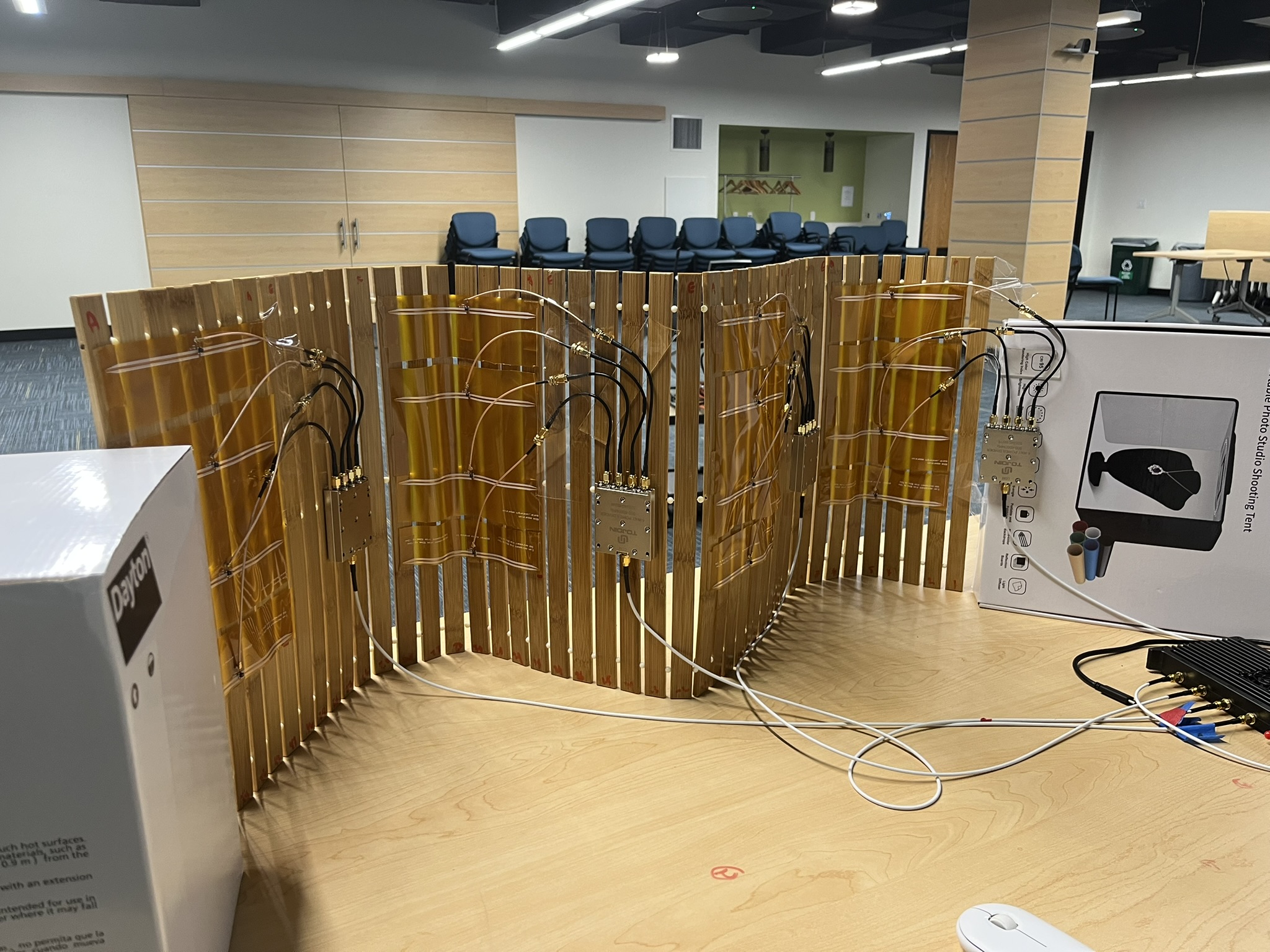 DeformRF: Data-driven Beamforming and Direction Finding with Deformable Antenna ArraysXingda Chen, Mohammad Mehdi Rastikerdar, Ankur Aditya, and 1 more authorIn Proceedings of the 24th Annual International Conference on Mobile Systems, Applications and Services, University of Cambridge, Cambridge, United Kingdom, 2026
Low-frequency antenna arrays enable obstacle-penetrating communications, but their large physical footprint—a 4x4 array at 150 MHz requires 16 m2—prevents practical deployment. DeformRF enables portable, deformable arrays that compress to backpack-size yet maintain beamforming performance when deployed on flexible substrates. Our key insight is that data-driven methods can predict complex electromagnetic behavior under deformation without real-time simulations. DeformRF combines: (1) a 260,000-sample synthetic dataset mapping deformations to EM characteristics, (2) physics-inspired ML models achieving >94% prediction accuracy on average, and (3) smartphone-based 3D reconstruction requiring no infrastructure. In real-world experiments, DeformRF maintains beamforming gains within 1 dB of optimal despite severe deformation, while baselines degrade by 4-10 dB. For emergency response scenarios, our 4x4 flexible array achieves ±5° direction-finding accuracy when tracking signals through buildings, enabling practical indoor deployment of large low-frequency arrays.
@inproceedings{deformrf,
  author = {Chen, Xingda and Rastikerdar, Mohammad Mehdi and Aditya, Ankur and Ganesan, Deepak},
  title = {DeformRF: Data-driven Beamforming and Direction Finding with Deformable Antenna Arrays},
  year = {2026},
  isbn = {9798400720277},
  publisher = {Association for Computing Machinery},
  address = {New York, NY, USA},
  url = {https://doi.org/10.1145/3745756.3809238},
  doi = {10.1145/3745756.3809238},
  booktitle = {Proceedings of the 24th Annual International Conference on Mobile Systems, Applications and Services},
  pages = {779--791},
  numpages = {13},
  keywords = {beamforming, machine learning, deformable arrays},
  location = {University of Cambridge, Cambridge, United Kingdom},
  series = {MobiSys '26},
}
2024
- CurtainNet
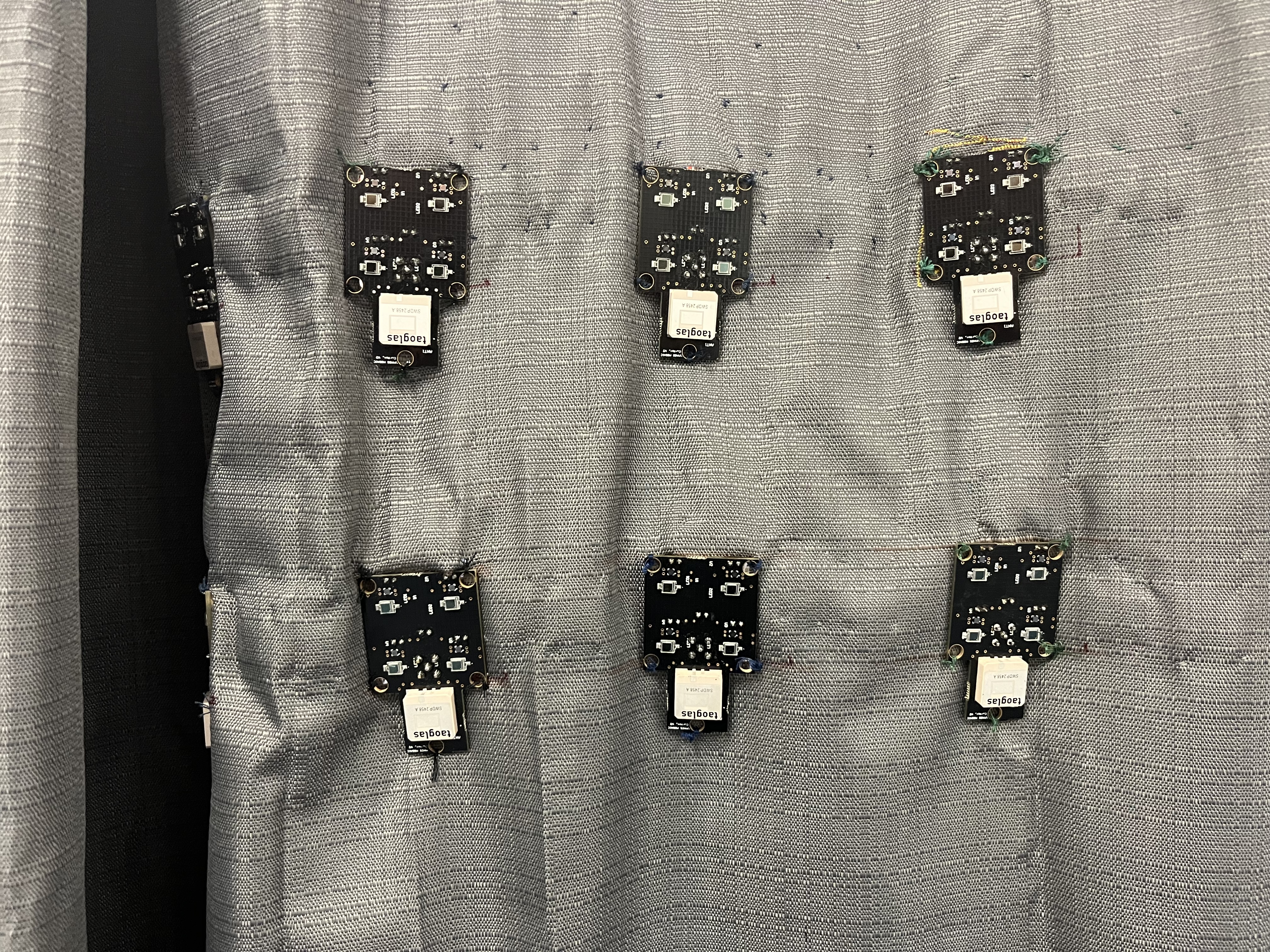 CurtainNet: Enabling precise beamforming with a deformable antenna array on a fabric substrateXingda Chen, Ankur Aditya, Zhenyu Lei, and 1 more authorIn Proceedings of the 21st ACM Conference on Embedded Networked Sensor Systems, Istanbul, Turkiye, 2024
Recent trends in flexible antennas and printed circuit boards present an opportunity to leverage deformable substrates such as textiles to deploy large UHF, VHF and ISM band antenna arrays in smart homes. Low-frequency large antenna arrays are rarely deployed in indoor settings due to their large size which makes them bulky and difficult to deploy. By embedding these arrays on existing surfaces such as curtains, we can improve through-wall sensing, beamforming for IoT devices equipped with low-power radios and indoor localization of Bluetooth tags.However, antenna arrays on curtains present new challenges since deformation shifts their phase centers and changes the 3D positions of antennas. We present CurtainNet, a flexible UHFband antenna array on a large surface curtain that leverages a combination of optical and RF tracking to compensate for these changes while dealing with occlusions and phase changes. Results show that CurtainNet outperforms alternative methods by more than 155% in beamforming performance and increases indoor range by 20m.
@inproceedings{curtainnet,
  author = {Chen, Xingda and Aditya, Ankur and Lei, Zhenyu and Ganesan, Deepak},
  title = {CurtainNet: Enabling precise beamforming with a deformable antenna array on a fabric substrate},
  year = {2024},
  isbn = {9798400704147},
  publisher = {Association for Computing Machinery},
  address = {New York, NY, USA},
  url = {https://doi.org/10.1145/3625687.3625787},
  doi = {10.1145/3625687.3625787},
  booktitle = {Proceedings of the 21st ACM Conference on Embedded Networked Sensor Systems},
  pages = {349–361},
  numpages = {13},
  keywords = {smart textile, novel radio network, beam-forming},
  location = {Istanbul, Turkiye},
  series = {SenSys '23},
}