Rasorbers
BTech Thesis Work
Frequency Selective Surfaces (FSS) are periodic structures designed to reflect, absorb, or transmit incident electromagnetic (EM) waves. FSS-based designs have contributed to reducing the weight and thickness of absorbers. Over the past few decades, various types of FSS have been developed for use in applications such as antennas, radomes, and rasorbers, due to their spatial filtering properties. Bandpass FSS, for instance, are commonly used in radome designs to achieve efficient transmission, but they can cause strong reflections outside the passband, significantly increasing radar cross-section (RCS).
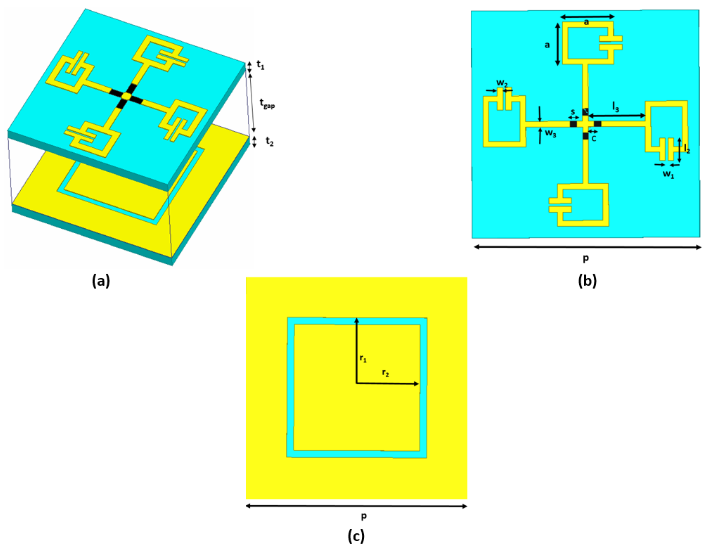
To address this issue, a new class of FSS, known as Frequency Selective Rasorbers (FSRs), has emerged in recent years. FSRs are periodic structures that allow EM wave transmission within a specific frequency band (passband) while absorbing waves outside of it. This makes FSRs a combination of an absorber and a spatial filter. Various FSR designs have been proposed, including those with a passband above, between, or below absorption bands. In this work, an FSS-based design for rasorbers with transmission band in between the abosrption bands is presented.
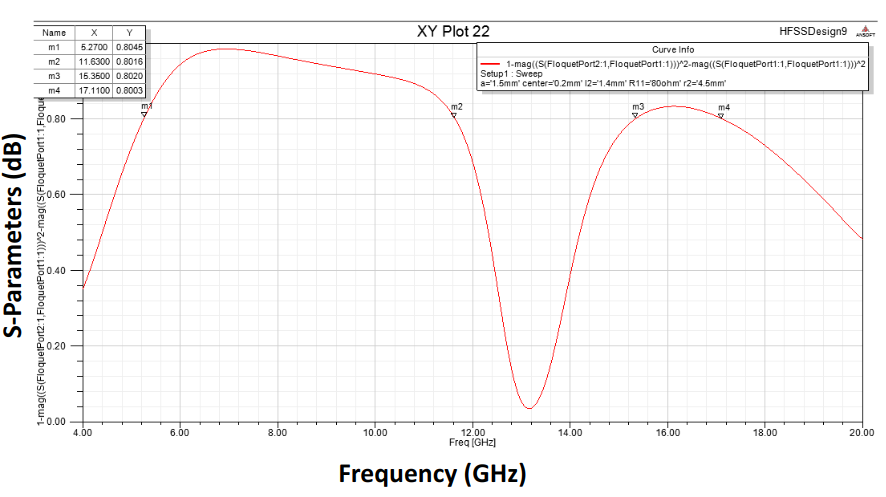
Key Take Away from the simulated results: Absorption rate is greater than 80% in the range of 5.27 GHz to 11.63 GHz for lower absorption band, and 15.35 GHz to 17.11 GHz for upper absorption band as shown in figure. The passpand is between 11.63 GHz and 15.35 GHz, with peak value insertion loss of 0.167 dB.